Polishing and Paint Correction
The Best Paint Thickness Gauge for Cars in 2026
Four pages on this site tell you to measure before you polish. This is the page about what to measure with, and the specification that matters is not the one the listings lead on.
By Sawyer V. · Last verified 2026-10-04
We have not tested any of this. Everything below is compiled from published manufacturer specifications, and the arithmetic is printed so you can check it. This page carries affiliate links: if you buy through one we earn a commission at no extra cost to you, and it does not change the order of the picks. Full disclosure.
| # | Pick | Best for | Score | Price |
|---|---|---|---|---|
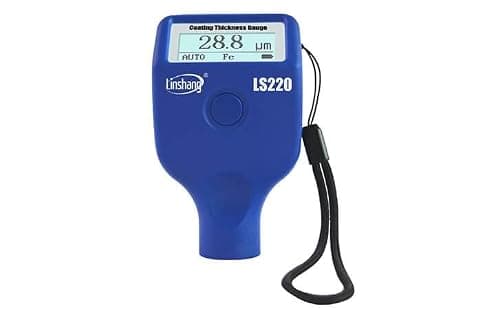
| 1 | Linshang LS220 Coating Thickness Gauge Linshang | The cheapest gauge here that publishes an accuracy figure | 8.8/10 | $127.00 - view on Amazon |
| 2 | Linshang LS223 Coating Thickness Gauge Linshang | A separate probe, if you measure awkward panels | 7.5/10 | $397.89 - view on Amazon |
| 3 | Elcometer 311 Automotive Paint Meter Elcometer | The body shop standard, with a published warranty | 4.9/10 | $917.28 - view on Amazon |
| 4 | Unbranded Digital Coating Thickness Gauge Unbranded | Nothing you can verify before you buy it | 4.3/10 | $24.99 - view on Amazon |
Prices last verified October 4, 2026. They move constantly; the figure on Amazon when you click is the real one.
What a gauge actually tells you, and what it does not
A coating thickness gauge sits on a panel and reports how much material is between its probe and the metal underneath, in microns. That is the whole function. It is the only way to turn "there is probably enough clear coat left" into a number, which is why four pages on this site already tell you to use one before you cut into paint.
What it does not do is separate the layers. None of the makers here publishes a layer-by-layer breakdown, and none claims one: the reading is the total film over the substrate, primer and base and clear together. A gauge tells you a panel reads thinner than the ones around it, which is the comparison that matters. It will not tell you how many microns of clear coat specifically remain, and anybody selling you that distinction on a consumer gauge is selling you something the specification does not support.
That makes the useful technique comparative rather than absolute. You take readings across panels, write them down, and look for the panel that reads low or wildly high. A low panel has been polished hard before or has thin paint; a high one has usually been resprayed. How many times a car can be polished covers why that budget is finite.
The three figures that decide a gauge
Accuracy is the one that matters and the one buyers skip. It is published as a formula, not a single number: the Linshang gauges quote plus or minus 3% of the reading plus 2 microns, Elcometer quotes plus or minus 5% or 20 microns. That formula is the width of the band your reading sits inside, and without it a displayed number means nothing.
Resolution is how finely the display steps, and it is routinely confused with accuracy. A gauge can show 0.1 micron steps and still be plus or minus 20 microns out. Resolution tells you what the screen can express; accuracy tells you what the instrument can be trusted to know. Both are published by all three makers below.
Substrate handling decides whether the gauge works on your car at all. Steel panels are read by magnetic induction or Hall effect; aluminum needs eddy current. A gauge that only does ferrous metal is blind on an aluminum hood, which is most of a modern bodyshell on plenty of cars. Two of the three below do both automatically; the Elcometer does it only in the FNF models.
Everything below is ranked on those published claims, with blanks printed rather than filled in. The field for this page was narrow by design: of the gauges that are actually purchasable, only two makers publish a specification at all, and that is the finding as much as the ranking is.
What each maker publishes
| Gauge | Price | Accuracy | Resolution | Range |
|---|---|---|---|---|
| Linshang LS220 | $127.00 | ±(3%H + 2 μm) to 3,000 μm | 0.1 μm | 0-5,000 μm |
| Linshang LS223 | $397.89 | ±(3%H + 2 μm) to 3,000 μm | 0.1 μm below 99.9 μm | 0-3,000 μm |
| Elcometer 311 | $917.28 | ±5% or ±20 μm | 10 μm | 0-500 μm |
| Unbranded $25 meter | $24.99 | Not published | Not published | Not published |
The cheapest gauge here publishes the tightest numbers
Read the table again, because it is the opposite of what the prices suggest. The $127 Linshang publishes plus or minus 3% plus 2 microns with 0.1 micron resolution. The $917 Elcometer publishes plus or minus 5% or 20 microns with 10 micron resolution. On paper the cheap gauge is the precise one.
Two honest qualifications, because a specification sheet is a claim rather than a measurement. Neither figure has been independently verified by anyone here; both are the maker's own statement. And a conservative specification is not the same as a worse instrument, because a maker selling into bodyshops and insurance work has a reason to quote a number it can defend on every unit rather than the best one a sample achieved.
What the comparison does prove is narrower and still useful: paying seven times more does not buy you a tighter published accuracy, so if a published figure is what you are buying on, the cheap one wins outright and you should stop reading here.
What the $917 actually buys
Three things, all published. Sixty-plus readings a minute, which matters when you are sweeping a whole car rather than spot-checking one fender. A one-year warranty against manufacturing defects, which is the only warranty term published by any gauge on this page. And a published physical specification down to the weight, 156 grams with batteries, the dimensions, the battery life and the humidity range it operates in.
There is a fourth thing that is real but unpublished: it is the gauge the trade recognizes. If you are producing a reading that somebody else has to accept — a buyer, a shop, an insurer — the instrument's name carries weight that a specification table does not. That is worth something, and it is honest to say it is not worth $790 to somebody checking their own car before a weekend of polishing.
Where the LS223 fits, and where it does not
The LS223 at $397.89 publishes the same accuracy formula as the $127 LS220. What the extra money buys is a separate F3N3 probe on a lead instead of a tip fixed into the base of the instrument, and a larger display. A probe on a lead reaches into door shuts, around mirror bases and into the recesses a one-piece gauge simply cannot sit flat against.
If you measure whole cars that is a real working advantage. If you are checking a car you are about to buy, or your own paint before correcting it, it is three times the price for ergonomics. It also reads slightly slower, 0.5 seconds against the LS220's 0.3, which is published and worth knowing if you take dozens of readings at a time.
Why the $25 meters are the one thing to avoid
The first page of results for this product is dominated by unbranded meters around $25, and they are the reason this page exists. They publish no accuracy, no resolution, no range, no substrate handling and no warranty, and there is no manufacturer page anywhere to check a claim against. The listing is the only document that exists.
For most products that is a quality risk you can take for $25. For a measuring instrument it is different in kind: the entire value of the tool is that its output can be trusted, and an unverifiable gauge produces a confident number with no stated error. You would be better informed using no gauge at all and working conservatively, because at least then you know you are estimating.
The panels a gauge cannot read at all
Every gauge here measures coating over metal, and the published specifications say which metal: iron by Hall effect, non-ferrous by eddy current. Neither Linshang nor Elcometer publishes any figure for measuring over plastic, and that is not an omission, it is how the instruments work. A plastic bumper, a composite fender, a carbon panel: all of them are outside what these gauges do.
That matters more than it sounds, because bumpers are where a lot of accident repair lives. A car can read perfectly even across every metal panel and still have a resprayed front bumper the gauge is blind to, so a clean set of readings is not the same thing as a clean car. It is one more reason the readings are a comparison exercise rather than a verdict.
The published minimum substrate thickness is the other limit worth knowing: Linshang state 0.2 mm for steel and 0.05 mm for non-ferrous, while Elcometer state 800 microns of steel and 300 microns of aluminum on their FNF gauges. Panels thinner than that are outside the specification, and so is anything you measure through a magnet or a dent filler.
Taking a reading that means something
All three makers publish a minimum measuring area of 25 mm across, and Linshang publish curvature limits too: 5 mm convex, 25 mm concave. Those two figures rule out most of the places people instinctively measure. A sharp body line, the crown of a wheel arch lip or the narrow flat between two swage lines is smaller or tighter than the probe can resolve, and a reading taken there is not wrong so much as undefined.
The method that works is dull and repetitive: take several readings on each panel in the flattest area you can find, write them all down, and only then compare. One reading per panel tells you very little, because the spread across a single panel is often wider than the difference you are hunting for. The reading rate matters here, which is why Elcometer publishing 60-plus readings a minute is a real feature rather than a spec-sheet flourish.
Who actually needs to own one
Fewer people than the internet suggests. If you wash and wax your own car and polish it once a year with a one-step, the paint budget is not the constraint and a gauge will sit in a drawer. The three cases where it earns its price are real, though.
Buying a used car is the strongest: a panel reading far above the others has been resprayed, which is information the seller may not have volunteered. Before heavy correction is the second, because a panel that reads thin is a panel to leave alone or treat with the gentlest thing that works. And before wet sanding is the third, where you are deliberately removing material and the wet sanding page assumes you know what is there.
For everyone else, the honest answer is that the money buys more real-world improvement spent on a better polisher or the right pads, and that working conservatively is a free substitute for measuring.
What to buy
- The gauge to buy on published figures: Linshang LS220, $127.00.
- You measure whole cars and want a probe on a lead: Linshang LS223, $397.89.
- You need a reading somebody else will accept: Elcometer 311, $917.28, with a published warranty.
- You want a published warranty at all: the Elcometer is the only one here with one.
- You want a $25 gauge: buy none and work conservatively instead. It is the better outcome.
Every pick, with the working
Each entry lists the specifications the maker publishes, the axis scores those specifications produce, and what you give up. Rows that read “Not published” are not omissions on our side: they are figures the maker will not commit to in writing, and they cost the product points on the transparency axis.
Our pickThe cheapest gauge here that publishes an accuracy figure
Linshang LS220 Coating Thickness Gauge
Linshang
$127.00 for a gauge whose maker publishes the whole specification: 0 to 5,000 microns, 0.1 micron resolution, and accuracy quoted as plus or minus 3% of the reading plus 2 microns. On car paint, which lives between about 80 and 200 microns, that is far more gauge than the job needs and it is the cheapest one here that will commit to a number.
- Measuring range
- 0.0-5,000 μm
- Accuracy
- 0-3,000 μm: ±(3%H + 2 μm); 3,000-5,000 μm: ±(5%H + 2 μm)
- Resolution
- 0.1 μm / 1 μm / 10 μm
- Substrates
- Fe by Hall effect, NFe by eddy current
- Reading interval
- 0.3 s
- Minimum measuring area
- 25 mm diameter
- Minimum substrate thickness
- Fe 0.2 mm / NFe 0.05 mm
- Power
- 2 x AAA
- Warranty
- Not published
What it does well
- Accuracy published as a formula, the figure that actually matters
- 0.1 micron resolution and a 0.3 second reading interval, both published
- Reads steel by Hall effect and aluminum by eddy current automatically
- Minimum measuring area, curvature limits and substrate thickness all published
Who it is not for
- A 5,000 micron range is wasted on car paint; you are paying for industrial headroom
- No warranty term published on the product page
- A ruby-tipped fixed probe cannot be replaced if you damage it
How this score was calculated
- Protection claimdropped
- Nothing in this category is bought on how long it lasts, so the axis is dropped and the other weights are re-normalized.
- Capabilitydropped
- No single published number decides capability in this category, so the axis is dropped rather than invented.
- Cost per ouncedropped
- This is not a consumable, so cost per ounce says nothing useful and the axis is dropped.
- Price against the ceiling8.7/10, weight 14%
- A listed $127.00 against the $950 one upgrade in this category realistically tops out at. A list price captured on the compile date, not a live price and not what you will pay.
- Written commitmentdropped
- Linshang publishes no warranty term on this product's own page, so the axis is dropped. On a tool that is worth noticing, and it costs the product points on transparency instead.
- Spec transparency8.9/10, weight 18%
- 8 of the 9 specifications we went looking for are published by Linshang. Every blank row below is something the maker will not put in writing, and it costs the product points here.
List price $127.00 per Amazon, captured on the compile date below. Not a live price and not what you will pay — the button is where the real number is.
Specifications from Linshang's LS220 product page, compiled September 8, 2026.
2A separate probe, if you measure awkward panels
Linshang LS223 Coating Thickness Gauge
Linshang
$397.89 for the same published accuracy as the $127 LS220, in a body that takes an F3N3 probe on a lead rather than a fixed tip in the base. You are paying roughly $270 for the probe arrangement and a larger screen, not for a more accurate instrument.
- Measuring range
- Fe 0.0-3,000 μm / NFe 0.0-3,000 μm
- Accuracy
- ±(3%H + 2 μm), 0-3,000 μm
- Resolution
- 0.1 μm below 99.9 μm; 1 μm to 999 μm
- Probe
- F3N3, separate probe on a lead
- Reading interval
- 0.5 s
- Minimum measuring area
- 25 mm diameter
- Minimum substrate thickness
- Fe 0.2 mm / NFe 0.05 mm
- Power
- 2 x AA
- Warranty
- Not published
What it does well
- Same published accuracy formula as the cheaper model, ±(3%H + 2 μm)
- Separate F3N3 probe reaches into panel gaps a fixed-tip gauge cannot
- 0.1 micron resolution published across the range it matters in
- 128 x 64 display, larger than the LS220's
Who it is not for
- About three times the price of the LS220 for the same published accuracy
- 0.5 second reading interval, slower than the LS220's 0.3
- No warranty term published on the product page
How this score was calculated
- Protection claimdropped
- Nothing in this category is bought on how long it lasts, so the axis is dropped and the other weights are re-normalized.
- Capabilitydropped
- No single published number decides capability in this category, so the axis is dropped rather than invented.
- Cost per ouncedropped
- This is not a consumable, so cost per ounce says nothing useful and the axis is dropped.
- Price against the ceiling5.8/10, weight 14%
- A listed $397.89 against the $950 one upgrade in this category realistically tops out at. A list price captured on the compile date, not a live price and not what you will pay.
- Written commitmentdropped
- Linshang publishes no warranty term on this product's own page, so the axis is dropped. On a tool that is worth noticing, and it costs the product points on transparency instead.
- Spec transparency8.9/10, weight 18%
- 8 of the 9 specifications we went looking for are published by Linshang. Every blank row below is something the maker will not put in writing, and it costs the product points here.
List price $397.89 per Amazon, captured on the compile date below. Not a live price and not what you will pay — the button is where the real number is.
Specifications from Linshang's LS223 product page, compiled September 8, 2026.
3The body shop standard, with a published warranty
Elcometer 311 Automotive Paint Meter
Elcometer
$917.28 for the gauge the trade buys, and the specification is the surprise: Elcometer publish ±5% or ±20 microns with 10 micron resolution, which on paper is coarser than a $127 Linshang. What the money buys is 60-plus readings a minute, a published warranty and an instrument built to be argued with in a bodyshop.
- Measuring range
- 0-500 μm / 0-20 mils
- Accuracy
- ±5% or ±20 μm (1.0 mil)
- Resolution
- 10 μm (0.5 mil)
- Reading rate
- 60+ readings per minute
- Substrates
- Steel (F), or steel and aluminum (FNF models)
- Minimum substrate thickness
- Steel 800 μm; aluminum 300 μm on FNF
- Weight
- 156 g (5.5 oz) with batteries
- Power
- 2 x AA or USB
- Warranty
- 1 year against manufacturing defects
What it does well
- Accuracy, resolution, range and minimum substrate thickness all published
- 60+ readings per minute published, which matters when you sweep a whole panel
- A published warranty: one year against manufacturing defects
- 156 g with batteries, and published dimensions, battery life and humidity range
Who it is not for
- 10 micron resolution and ±20 μm accuracy are coarser figures than the cheaper gauges here publish
- $917.28 is seven times the LS220 for a 0-500 μm range rather than 0-5,000
- Aluminum measurement needs the FNF model, not the base steel-only version
How this score was calculated
- Protection claimdropped
- Nothing in this category is bought on how long it lasts, so the axis is dropped and the other weights are re-normalized.
- Capabilitydropped
- No single published number decides capability in this category, so the axis is dropped rather than invented.
- Cost per ouncedropped
- This is not a consumable, so cost per ounce says nothing useful and the axis is dropped.
- Price against the ceiling0.3/10, weight 14%
- A listed $917.28 against the $950 one upgrade in this category realistically tops out at. A list price captured on the compile date, not a live price and not what you will pay.
- Written commitment2.0/10, weight 10%
- 12 months in writing, scored against a 60-month band. It is the only promise in the whole listing a court would read.
- Spec transparency10.0/10, weight 18%
- 9 of the 9 specifications we went looking for are published by Elcometer. Every blank row below is something the maker will not put in writing, and it costs the product points here.
List price $917.28 per Amazon, captured on the compile date below. Not a live price and not what you will pay — the button is where the real number is.
Specifications from Elcometer's 311 product page, compiled September 8, 2026.
4Nothing you can verify before you buy it
Unbranded Digital Coating Thickness Gauge
Unbranded
Skip this one. $24.99 for an instrument with no manufacturer, no product page and no published accuracy, range or resolution. A gauge exists to replace a guess with a number; one that will not publish its own error gives you a number you cannot check, which is worse than knowing you were guessing.
$24.99 for the kind of gauge that fills the first page of search results: no manufacturer, no product page, and not one published figure for accuracy, range or resolution. A measuring instrument whose error you cannot look up is not a cheap gauge, it is a number generator.
- Measuring range
- Not published
- Accuracy
- Not published
- Resolution
- Not published
- Substrates
- Not published
- Manufacturer page
- Not published
- Warranty
- Not published
What it does well
- $24.99 is a fifth of the cheapest gauge here that publishes a specification
- In stock and widely available
Who it is not for
- No accuracy figure published anywhere
- No manufacturer product page exists to check any claim against
- No published range, resolution, substrate handling or warranty
How this score was calculated
- Protection claimdropped
- Nothing in this category is bought on how long it lasts, so the axis is dropped and the other weights are re-normalized.
- Capabilitydropped
- No single published number decides capability in this category, so the axis is dropped rather than invented.
- Cost per ouncedropped
- This is not a consumable, so cost per ounce says nothing useful and the axis is dropped.
- Price against the ceiling9.7/10, weight 14%
- A listed $24.99 against the $950 one upgrade in this category realistically tops out at. A list price captured on the compile date, not a live price and not what you will pay.
- Written commitmentdropped
- Unbranded publishes no warranty term on this product's own page, so the axis is dropped. On a tool that is worth noticing, and it costs the product points on transparency instead.
- Spec transparency0.0/10, weight 18%
- 0 of the 6 specifications we went looking for are published by Unbranded. Every blank row below is something the maker will not put in writing, and it costs the product points here.
List price $24.99 per Amazon, captured on the compile date below. Not a live price and not what you will pay — the button is where the real number is.
Specifications from The listing on Amazon, which is the only page that exists for it, compiled September 8, 2026.
Prices last verified October 4, 2026. They move constantly; the figure on Amazon when you click is the real one.
Questions people actually ask
+How accurate is a cheap paint thickness gauge?
+Can a paint thickness gauge measure clear coat on its own?
+Do I need a gauge that reads aluminum?
+Is resolution the same as accuracy?
+What reading means a panel has been resprayed?
Where these figures came from
- Linshang's LS220 product page — retrieved 2026-10-04
- Linshang's LS223 product page — retrieved 2026-10-04
- Elcometer's 311 Automotive Paint Meter page — retrieved 2026-10-04
Every figure on this page is a published manufacturer or authorized-retailer claim, not a measurement we made. How we research explains exactly what we did and did not do.