Wash and Decontamination
Clay Bar vs Clay Mitt
Both remove bonded contamination. One is precise and disposable, the other is fast and reusable, and the right answer depends on whether you are doing a panel or a car.
By Sawyer V. · Last verified 2026-09-08
We have not tested any of this. Everything below is compiled from published manufacturer specifications, and the arithmetic is printed so you can check it. This page carries affiliate links: if you buy through one we earn a commission at no extra cost to you, and it does not change the order of the picks. Full disclosure.
Top pick
| # | Pick | Best for | Score | Price |
|---|---|---|---|---|
| 1 | ULTRA Clay Mitt The Rag Company | Doing a whole car without losing an afternoon | 4.3/10 | $41.95 - view on Amazon |
| 2 | Koch-Chemie Clay Bar Koch-Chemie | The only clay here that publishes its grade | 4.6/10 | $46.99 - view on Amazon |
Prices last verified October 23, 2026. They move constantly; the figure on Amazon when you click is the real one.
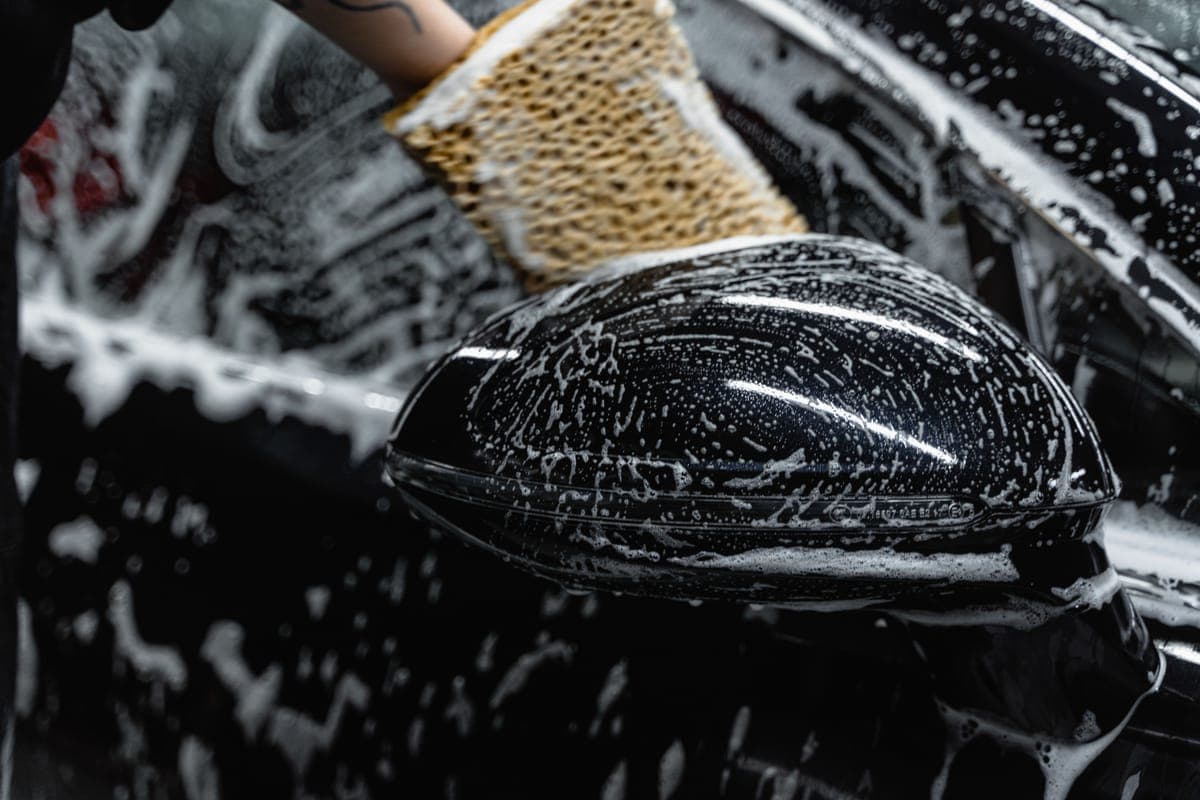
Same mechanism, different handling
Both media work by shearing off contamination that protrudes above the clear coat while lubricant carries the debris away. The chemistry is broadly the same; what differs is the shape, the surface area, and what happens when it hits the floor.
| Clay mitt | Clay bar | |
|---|---|---|
| Example | ULTRA Clay Mitt, 8.7 x 5.7 in | Koch-Chemie Clay Bar, 200g |
| Price | $35.10 | $39.59 |
| Published grade | Not published | Blue mild / Red stronger |
| Coverage per pass | Large | Small |
| Precision around badges | Poor | Excellent |
| If you drop it | Rinse and continue | Throw it away |
| Reusable | Yes, rinsed between panels | Yes, until dropped or fully loaded |
| Conforms to curves | Moderate | Completely |
The dropped bar is not a hypothetical
A clay bar is soft, slightly tacky and roughly the size of a bar of soap, handled with wet hands over a hard floor. It gets dropped. And a dropped bar has picked up whatever was on that floor, which means using it again is dragging grit across your paint under pressure.
This is the single strongest practical argument for a mitt or a block, and it is why Adam’s foam-backed block exists at $8.99: the foam gives your hand something to grip so the medium does not slip in the first place. If your garage floor is concrete and your hands are wet, that nine dollars is well spent.
Where the bar wins outright
A bar can be pressed into shape around a badge, worked along a panel gap, folded to reach a mirror stalk and pinched thin for a door handle recess. A mitt is a flat plane on a soft backing, and it bridges over exactly those features. On a car with a lot of trim detail, the bar reaches contamination the mitt never touches.
The other thing a bar gives you is feedback. You feel the surface change as the contamination comes off, which is how you know when a panel is done. A mitt is less communicative, and people using one for the first time tend to keep going after the job is finished.
Grade, and the one maker who publishes it
Clay comes in grades and grade determines marring. Koch-Chemie is the only maker in this comparison — and the only one in the whole clay roundup — that publishes which grade you are buying: blue is mild, red is stronger.
On soft paint that distinction is not academic. A heavy-grade medium leaves fine marring that has to be polished out, which converts a two-hour decontamination job into a correction job. If you do not know your paint’s hardness, start with the mildest grade available and see whether it is sufficient.
The practical answer
- Doing a whole car once or twice a year: buy the mitt. Speed and drop-resistance both matter over four hours of work.
- Doing spot decontamination on a few panels: buy a bar. Cheaper and more precise.
- Working on a car with heavy trim, badges and complex bumpers: own both. Total cost around $50.
- Working on soft or single-stage paint: buy the graded bar and start with the mild version.
- On a budget: Adam's foam-backed block at $8.99 does most of what a mitt does and survives the floor.
Every pick, with the working
Each entry lists the specifications the maker publishes, the axis scores those specifications produce, and what you give up. Rows that read “Not published” are not omissions on our side: they are figures the maker will not commit to in writing, and they cost the product points on the transparency axis.
Our pickDoing a whole car without losing an afternoon
ULTRA Clay Mitt
The Rag Company
$35.10 for an 8.7 by 5.7 inch mitt, which is the only published dimension in this clay group. A mitt covers a panel in a fraction of the passes a bar needs, and it survives the floor.
- Dimensions
- 8.7 in x 5.7 in
- Format
- Mitt
- Stated position
- Use before waxing, buffing and polishing
- Grade
- Not published
- Stated lifespan
- Not published
What it does well
- Dimensions published, so you know the coverage per pass before buying
- Survives being dropped, unlike a bar
- Explicitly positioned as an evolution of the bar rather than a different job
Who it is not for
- $35.10 is over four times the price of a clay bar
- No grade published
- A mitt is less precise than a bar around badges and edges
How this score was calculated
- Protection claimdropped
- Nothing in this category is bought on how long it lasts, so the axis is dropped and the other weights are re-normalized.
- Capabilitydropped
- No single published number decides capability in this category, so the axis is dropped rather than invented.
- Cost per ouncedropped
- Either the list price or the container size is unpublished, so the division cannot be done and the axis is dropped.
- Price against the ceiling2.2/10, weight 14%
- A listed $35.10 against the $45 one upgrade in this category realistically tops out at. A list price captured on the compile date, not a live price and not what you will pay.
- Written commitmentdropped
- The Rag Company publishes no warranty term on this product's own page, so the axis is dropped. On a tool that is worth noticing, and it costs the product points on transparency instead.
- Spec transparency6.0/10, weight 18%
- 3 of the 5 specifications we went looking for are published by The Rag Company. Every blank row below is something the maker will not put in writing, and it costs the product points here.
List price $35.10 per The Rag Company, captured on the compile date below. Not a live price and not what you will pay — the button is where the real number is.
Specifications from The Rag Company's ULTRA Clay Mitt listing, compiled September 8, 2026.
2The only clay here that publishes its grade
Koch-Chemie Clay Bar
Koch-Chemie
$39.59 for 200 grams, in blue (mild) or red (a more aggressive grade), and it is the only clay in this ledger that tells you which is which before you buy. Weight and grade published on one page is the whole reason it costs more than double the alternatives.
- Weight
- 200 grams
- Grades
- Blue = mild cleaning clay; Red = stronger cleaning clay
- Stated contaminants
- Tree resin, insects, rust bloom, brake dust, overspray, tar, limescale
- Stated surfaces
- Paintwork and glass
- Lubricant included
- Not published
What it does well
- Grade published: blue is stated mild, red is the stronger cleaning clay
- 200 grams published, which is roughly twice a standard consumer bar
- Named for tree resin, rust bloom, brake dust, tar and overspray specifically
Who it is not for
- $39.59 is more than double the cheap bars
- No lubricant included at that price
- Professional sizing is more clay than a once-a-year decontamination needs
How this score was calculated
- Protection claimdropped
- Nothing in this category is bought on how long it lasts, so the axis is dropped and the other weights are re-normalized.
- Capabilitydropped
- No single published number decides capability in this category, so the axis is dropped rather than invented.
- Cost per ounce3.7/10, weight 16%
- $39.59 for 7.05 oz works out at $5.62 an ounce, scored against a band of $1.50 (good) to $8.00 (expensive) for a clay.
- Price against the ceiling1.2/10, weight 14%
- A listed $39.59 against the $45 one upgrade in this category realistically tops out at. A list price captured on the compile date, not a live price and not what you will pay.
- Written commitmentdropped
- Koch-Chemie publishes no warranty term on this product's own page, so the axis is dropped. On a tool that is worth noticing, and it costs the product points on transparency instead.
- Spec transparency8.0/10, weight 18%
- 4 of the 5 specifications we went looking for are published by Koch-Chemie. Every blank row below is something the maker will not put in writing, and it costs the product points here.
List price $39.59 per The Rag Company, 200g, captured on the compile date below. Not a live price and not what you will pay — the button is where the real number is.
Specifications from The Rag Company's Koch-Chemie Clay Bar listing, compiled September 8, 2026.
Prices last verified October 23, 2026. They move constantly; the figure on Amazon when you click is the real one.
Questions people actually ask
+Do clay mitts scratch paint?
+How long does a clay mitt last?
+Can I use a clay mitt on glass?
+Which one removes more contamination?
Where these figures came from
- The Rag Company, ULTRA Clay Mitt listing — retrieved 2026-09-08
- The Rag Company, Koch-Chemie Clay Bar listing — retrieved 2026-09-08
Every figure on this page is a published manufacturer or authorized-retailer claim, not a measurement we made. How we research explains exactly what we did and did not do.