Wash and Decontamination
Chemical Decontamination, Explained
Chemical decon dissolves what is bonded to your paint so the mechanical stage has less to shear off. Doing it in the wrong order costs you clear coat.
By Sawyer V. · Last verified 2026-09-08
We have not tested any of this. Everything below is compiled from published manufacturer specifications, and the arithmetic is printed so you can check it. This page carries affiliate links: if you buy through one we earn a commission at no extra cost to you, and it does not change the order of the picks. Full disclosure.
Top pick
| # | Pick | Best for | Score | Price |
|---|---|---|---|---|
| 1 | Adam's Iron Remover Adam's Polishes | The default, and the one with the clearest safety wording | 7.0/10 | $67.99 - view on Amazon |
| 2 | Gtechniq W6 Iron and General Fallout Remover Gtechniq | The only one here with a corrosion inhibitor in it | 6.3/10 | $16.95 - view on Amazon |
| 3 | Koch-Chemie Magic Wheel Cleaner Koch-Chemie | Iron-reactive cleaning on a coated wheel | 5.8/10 | $24.99 - view on Amazon |
| 4 | ULTRA Clay Mitt The Rag Company | Doing a whole car without losing an afternoon | 4.3/10 | $41.95 - view on Amazon |
Prices last verified October 23, 2026. They move constantly; the figure on Amazon when you click is the real one.
What is actually stuck to your paint
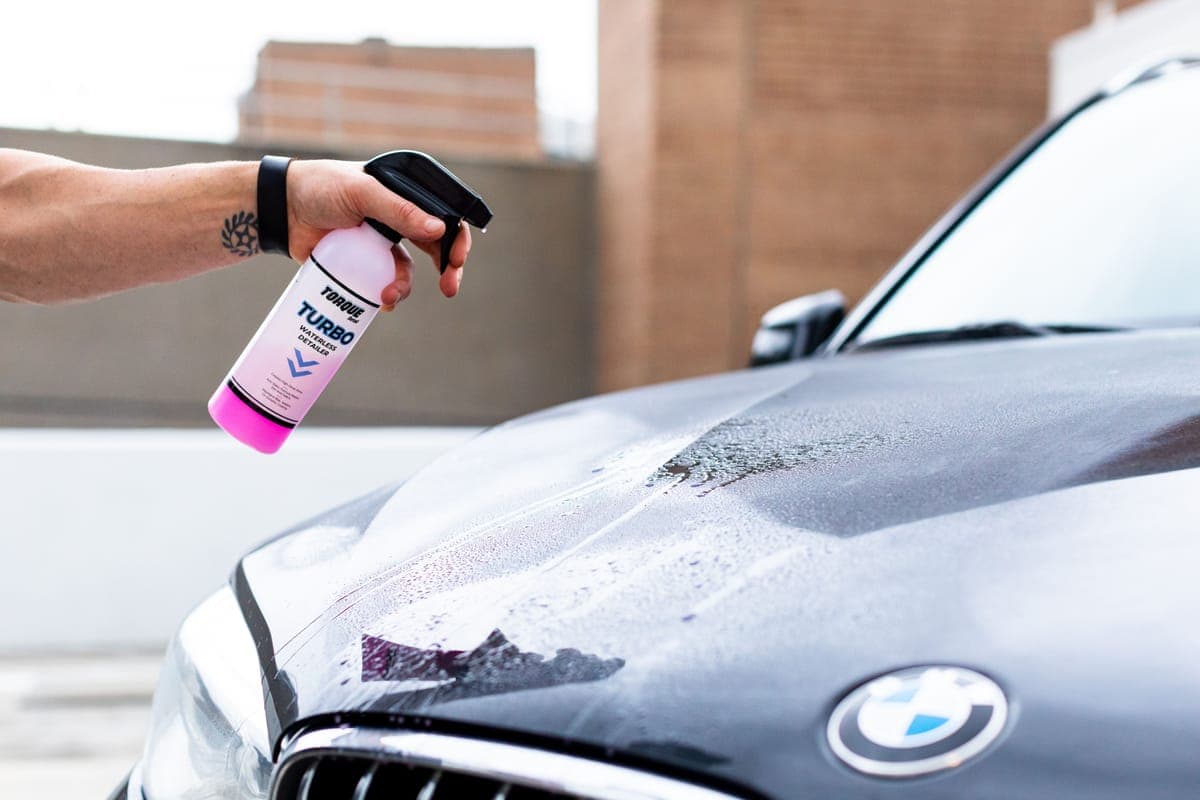
Three things, mostly. Ferrous particles from brake pads and rail dust, which embed in clear coat and oxidize in place — the orange speckling on a white car. Tar and road oils from fresh asphalt, concentrated on lower panels and behind the wheels. And overspray, sap and industrial fallout, which sit proud of the surface.
Soap removes none of these, because none of them is loose. That is the entire reason decontamination exists as a separate stage, and it is why a car that feels rough after a thorough wash is not a car that was washed badly.
Why chemical goes first
Clay works mechanically: it shears off contamination that protrudes above the clear coat, with lubricant carrying the debris away. Every particle it shears is a particle being dragged across the paint for a fraction of a second, and each one is a marring opportunity.
An iron remover dissolves the ferrous portion chemically instead — the color change from clear to purple is the reaction converting bonded iron into a water-soluble complex that simply rinses off. Do that first and the clay stage has substantially less to remove, which means fewer passes, less marring, and a clay medium that lasts longer.
What is in the bottle, as far as anyone publishes
| Product type | What it dissolves | Stated chemistry on this site |
|---|---|---|
| Iron remover | Bonded ferrous particles from brake and rail dust | Adam's: pH neutral, acid-free. Gtechniq W6: corrosion inhibitor and acid rain neutralizer named. |
| Iron-reactive wheel cleaner | The same chemistry aimed at wheels, often with stronger cleaning agents | Koch-Chemie MWC: acid-free, viscous, red color change. |
| Alkaline pre-wash | Road film and organic soiling, touchlessly | Chemical Guys Hands Off: alkaline, stated. |
| Clay lubricant | Nothing; it carries away what the clay shears | Not a decontamination chemical, and not optional either. |
The full sequence
- 1Wash normally. Chemical decon on a dirty car spends expensive chemistry dissolving nothing. Two buckets, dried or not — you are about to get it wet again.
- 2Wheels first. They carry the heaviest ferrous load. Spray an iron remover or an iron-reactive wheel cleaner, let the color develop, agitate with a brush, rinse.
- 3Paint next, panel by panel. Lower panels and the rear of the car carry the most fallout. Never let the product dry.
- 4Tar where you find it. Usually behind the wheels and along the sills. A dedicated tar remover, applied locally rather than over the whole car.
- 5Rinse completely. Everything off, before anything mechanical starts.
- 6Clay. With generous lubricant — the claying guide covers the method.
- 7Protect the same day. The car now has nothing on it at all.
How often, and how to tell
Twice a year for a car parked outside, once for a garaged one, is a reasonable default. The signals are visual and tactile: orange speckling on light paint, roughness through a plastic bag on any color. Doing it more often than the contamination warrants removes protection you just paid for and gains nothing.
On a coated car, decontamination is a bigger decision, because the chemical stage is at least somewhat aggressive toward the coating and the mechanical stage removes it outright. If a coated car has bonded contamination, the honest answer is usually that the coating is near the end of its life anyway — the durability page covers how to tell.
Every pick, with the working
Each entry lists the specifications the maker publishes, the axis scores those specifications produce, and what you give up. Rows that read “Not published” are not omissions on our side: they are figures the maker will not commit to in writing, and they cost the product points on the transparency axis.
Our pickThe default, and the one with the clearest safety wording
Adam's Iron Remover
Adam's Polishes
16oz at $16.99, pH neutral, acid-free, ready to use with no dilution, and stated safe on clear coat and single-stage paint. Four safety-relevant claims on one page is more than anything else in this class publishes.
- Sizes
- 16oz / gallon / 5 gallon
- pH
- Stated pH neutral, acid-free
- Dilution
- Ready to use, no dilution
- Stated paint safety
- Clear coat and single-stage paint
- Color change
- Turns red as it reacts with ferrous contamination
- Dwell time
- Not published
- Coverage
- Not published
What it does well
- pH neutral and acid-free, both stated plainly
- Explicitly stated safe on single-stage paint, which most iron removers do not address at all
- Ready to use, so there is no dilution to get wrong
- Gallon and five-gallon sizes for anyone decontaminating regularly
Who it is not for
- No pH figure published, only the word neutral
- No dwell time published, and dwell is what decides whether it works or dries on
- No coverage figure published
How this score was calculated
- Protection claimdropped
- Nothing in this category is bought on how long it lasts, so the axis is dropped and the other weights are re-normalized.
- Capabilitydropped
- No single published number decides capability in this category, so the axis is dropped rather than invented.
- Cost per ounce8.0/10, weight 16%
- $16.99 for 16 oz works out at $1.06 an ounce, scored against a band of $0.70 (good) to $2.50 (expensive) for a iron remover.
- Price against the ceiling5.8/10, weight 14%
- A listed $16.99 against the $40 one upgrade in this category realistically tops out at. A list price captured on the compile date, not a live price and not what you will pay.
- Written commitmentdropped
- Adam's Polishes publishes no warranty term on this product's own page, so the axis is dropped. On a tool that is worth noticing, and it costs the product points on transparency instead.
- Spec transparency7.1/10, weight 18%
- 5 of the 7 specifications we went looking for are published by Adam's Polishes. Every blank row below is something the maker will not put in writing, and it costs the product points here.
List price $16.99 per Adam's Polishes' own store, 16oz, captured on the compile date below. Not a live price and not what you will pay — the button is where the real number is.
Specifications from Adam's Iron Remover product page, compiled September 8, 2026.
2The only one here with a corrosion inhibitor in it
Gtechniq W6 Iron and General Fallout Remover
Gtechniq
250ml at $9.95 up to 5 liters at $94.95, and the only iron remover on this page whose listing names a corrosion inhibitor and an acid-rain neutralizing additive. Both are things this chemistry can leave behind after it has done its job.
- Sizes
- 250ml / 500ml / 1 liter / 5 liter
- Additives
- Corrosion inhibitor, acid rain neutralizer
- Stated surfaces
- Paint and wheels
- pH
- Not published
- Dwell time
- Not published
- Coverage
- Not published
What it does well
- Corrosion inhibitor named as part of the formula, not an afterthought
- Acid rain neutralizing additive named separately
- Four sizes from 250ml to 5 liters; $9.95 to try it
Who it is not for
- No pH figure or pH-neutral claim published
- No dwell time published
- Gtechniq's own site is behind a bot challenge, so the manufacturer page could not be checked
How this score was calculated
- Protection claimdropped
- Nothing in this category is bought on how long it lasts, so the axis is dropped and the other weights are re-normalized.
- Capabilitydropped
- No single published number decides capability in this category, so the axis is dropped rather than invented.
- Cost per ounce8.3/10, weight 16%
- $16.95 for 16.91 oz works out at $1.00 an ounce, scored against a band of $0.70 (good) to $2.50 (expensive) for a iron remover.
- Price against the ceiling5.8/10, weight 14%
- A listed $16.95 against the $40 one upgrade in this category realistically tops out at. A list price captured on the compile date, not a live price and not what you will pay.
- Written commitmentdropped
- Gtechniq publishes no warranty term on this product's own page, so the axis is dropped. On a tool that is worth noticing, and it costs the product points on transparency instead.
- Spec transparency5.0/10, weight 18%
- 3 of the 6 specifications we went looking for are published by Gtechniq. Every blank row below is something the maker will not put in writing, and it costs the product points here.
List price $16.95 per The Rag Company, 500ml, captured on the compile date below. Not a live price and not what you will pay — the button is where the real number is.
Specifications from The Rag Company's Gtechniq W6 listing (authorized retailer), compiled September 8, 2026.
3Iron-reactive cleaning on a coated wheel
Koch-Chemie Magic Wheel Cleaner
Koch-Chemie
500ml at $20.69, acid-free, viscous, and iron-reactive with the red color change that tells you it is doing something. It is the wheel cleaner to use on a coated wheel, because acid is what kills a wheel coating early.
- Sizes
- 500ml / 5 liter
- Chemistry
- Acid-free, viscous
- Indicator
- Red discoloration as it reacts with iron
- Stated surfaces
- Rims and rim wells
- pH
- Not published
- Dilution ratio
- Not published
- Dwell time
- Not published
What it does well
- Acid-free, which is the specification that matters on a coated or polished wheel
- Viscous, so it stays where you sprayed it long enough to work
- Named dispersing agents rather than a generic surfactant claim
Who it is not for
- $1.22 an ounce is nearly six times P&S per ounce
- No dilution ratio published
- No pH figure or dwell time published
How this score was calculated
- Protection claimdropped
- Nothing in this category is bought on how long it lasts, so the axis is dropped and the other weights are re-normalized.
- Capabilitydropped
- No single published number decides capability in this category, so the axis is dropped rather than invented.
- Cost per ounce6.7/10, weight 16%
- $20.69 for 16.91 oz works out at $1.22 an ounce, scored against a band of $0.60 (good) to $2.50 (expensive) for a wheel cleaner.
- Price against the ceiling4.8/10, weight 14%
- A listed $20.69 against the $40 one upgrade in this category realistically tops out at. A list price captured on the compile date, not a live price and not what you will pay.
- Written commitmentdropped
- Koch-Chemie publishes no warranty term on this product's own page, so the axis is dropped. On a tool that is worth noticing, and it costs the product points on transparency instead.
- Spec transparency5.7/10, weight 18%
- 4 of the 7 specifications we went looking for are published by Koch-Chemie. Every blank row below is something the maker will not put in writing, and it costs the product points here.
List price $20.69 per The Rag Company, 500ml, captured on the compile date below. Not a live price and not what you will pay — the button is where the real number is.
Specifications from The Rag Company's Koch-Chemie MWC listing, compiled September 8, 2026.
4Doing a whole car without losing an afternoon
ULTRA Clay Mitt
The Rag Company
$35.10 for an 8.7 by 5.7 inch mitt, which is the only published dimension in this clay group. A mitt covers a panel in a fraction of the passes a bar needs, and it survives the floor.
- Dimensions
- 8.7 in x 5.7 in
- Format
- Mitt
- Stated position
- Use before waxing, buffing and polishing
- Grade
- Not published
- Stated lifespan
- Not published
What it does well
- Dimensions published, so you know the coverage per pass before buying
- Survives being dropped, unlike a bar
- Explicitly positioned as an evolution of the bar rather than a different job
Who it is not for
- $35.10 is over four times the price of a clay bar
- No grade published
- A mitt is less precise than a bar around badges and edges
How this score was calculated
- Protection claimdropped
- Nothing in this category is bought on how long it lasts, so the axis is dropped and the other weights are re-normalized.
- Capabilitydropped
- No single published number decides capability in this category, so the axis is dropped rather than invented.
- Cost per ouncedropped
- Either the list price or the container size is unpublished, so the division cannot be done and the axis is dropped.
- Price against the ceiling2.2/10, weight 14%
- A listed $35.10 against the $45 one upgrade in this category realistically tops out at. A list price captured on the compile date, not a live price and not what you will pay.
- Written commitmentdropped
- The Rag Company publishes no warranty term on this product's own page, so the axis is dropped. On a tool that is worth noticing, and it costs the product points on transparency instead.
- Spec transparency6.0/10, weight 18%
- 3 of the 5 specifications we went looking for are published by The Rag Company. Every blank row below is something the maker will not put in writing, and it costs the product points here.
List price $35.10 per The Rag Company, captured on the compile date below. Not a live price and not what you will pay — the button is where the real number is.
Specifications from The Rag Company's ULTRA Clay Mitt listing, compiled September 8, 2026.
Prices last verified October 23, 2026. They move constantly; the figure on Amazon when you click is the real one.
Questions people actually ask
+Do I need an iron remover if I clay the car?
+Can I use iron remover on a ceramic coated car?
+What causes the orange spots on white paint?
+How long should I let iron remover dwell?
Where these figures came from
- Adam's Polishes, Iron Remover product page — retrieved 2026-09-08
- The Rag Company, Gtechniq W6 listing — retrieved 2026-09-08
- The Rag Company, Koch-Chemie Magic Wheel Cleaner listing — retrieved 2026-09-08
Every figure on this page is a published manufacturer or authorized-retailer claim, not a measurement we made. How we research explains exactly what we did and did not do.